
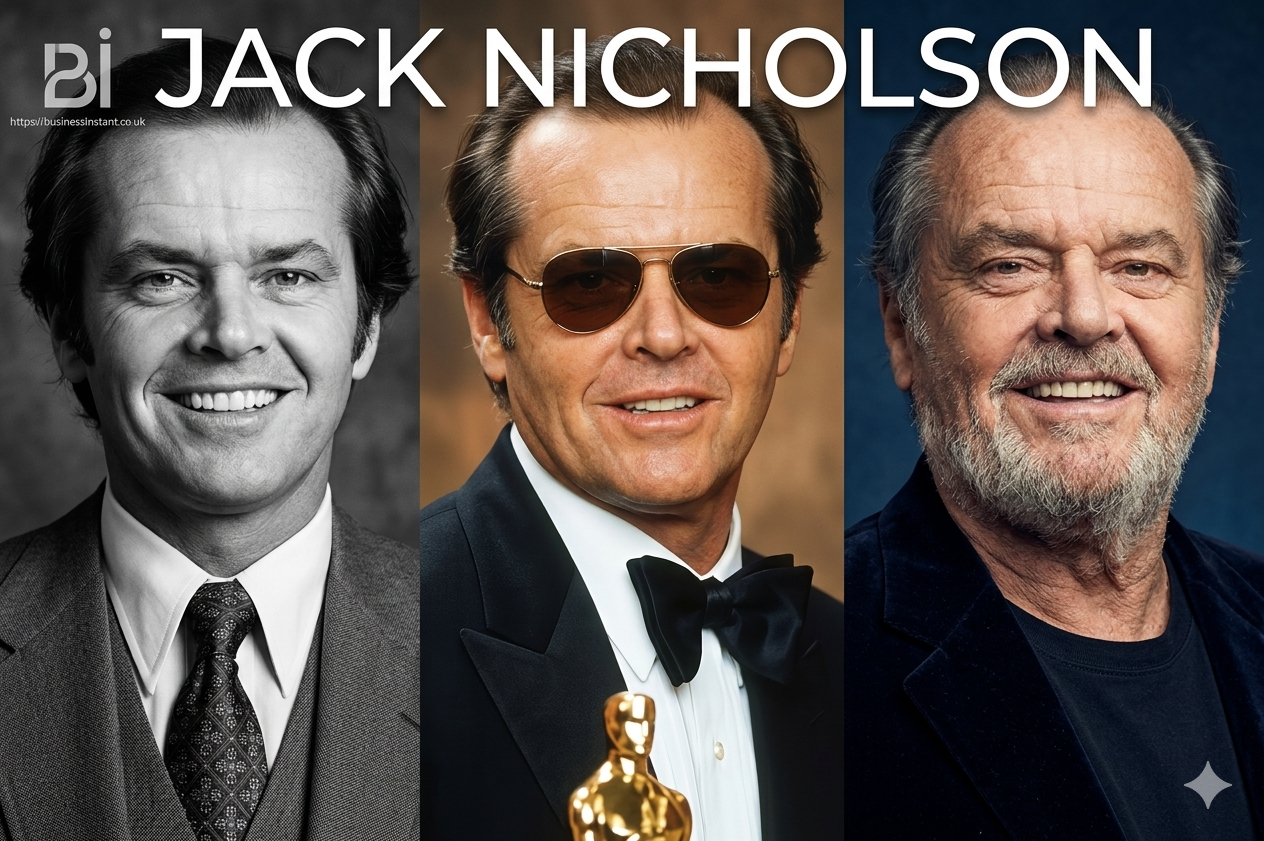

Introduction
Jack Nicholson is one of the most celebrated actors in American cinema, renowned for his charismatic intensity, devilish grin, and unforgettable performances. Over a career spanning more than five decades, Nicholson has delivered some of the most iconic roles in film history, from troubled antiheroes to playful villains. His ability to combine charm, menace, humor, and vulnerability in a single performance has made him a standout figure in Hollywood, admired by audiences and fellow actors alike. Beyond his screen presence, Nicholson’s personality, relationships, and lifestyle have contributed to his status as a cultural icon.
Early Life and Background
Jack Nicholson was born John Joseph Nicholson on April 22, 1937, in Neptune, New Jersey. His early life was unusual and complex; he was raised by his maternal grandparents and initially believed his mother was his sister. Growing up in a small New Jersey town during the mid-20th century, Nicholson developed an early fascination with film and performance. He was drawn to storytelling and the dramatic arts from a young age, which would shape the trajectory of his life.
As a young man, Nicholson moved to California, where he briefly worked in an office at a film studio. This exposure to Hollywood inspired him to pursue acting seriously, eventually enrolling in acting classes and working in theater before making the transition to film. His early experiences taught him resilience, independence, and the craft needed to succeed in a highly competitive industry.
Early Career and Breakthrough
Nicholson’s first film appearances came in the late 1950s and early 1960s in low-budget movies and supporting roles. These early performances allowed him to develop his craft and establish connections in the film industry. While these roles were small, they helped him refine his style and begin building a reputation as a versatile and committed actor.
His breakthrough came with the 1969 film Easy Rider, in which Nicholson played George Hanson, a lawyer caught in the countercultural journey of the protagonists. This role earned him his first Academy Award nomination and showcased his ability to portray complex, emotionally resonant characters. Nicholson’s performance in Easy Rider established him as a rising star capable of combining humor, pathos, and intensity in a single role.
The 1970s: Rise to Stardom
The 1970s were a defining decade for Nicholson. He starred in Five Easy Pieces (1970), playing a disaffected, alienated man navigating family and societal expectations. The role received critical acclaim and cemented his reputation as a serious actor. Nicholson continued to take bold roles in films like Carnal Knowledge (1971), which explored complex emotional and sexual dynamics, and Chinatown (1974), where he portrayed private detective Jake Gittes with a perfect balance of cynicism, vulnerability, and determination.
One of Nicholson’s most celebrated roles came in One Flew Over the Cuckoo’s Nest (1975), where he played Randle McMurphy, a rebellious and free-spirited patient in a mental institution. Nicholson’s performance earned him the Academy Award for Best Actor and became one of the most iconic portrayals in cinematic history. The combination of defiance, humor, and deep emotional insight in McMurphy remains a hallmark of Nicholson’s style.
Iconic Roles and the 1980s
Nicholson continued his dominance in the 1980s with a series of memorable performances. He starred in The Shining (1980), directed by Stanley Kubrick, portraying Jack Torrance, a writer driven to madness. His intense and terrifying performance is still regarded as one of the greatest in horror cinema. In Terms of Endearment (1983), Nicholson displayed his comedic and dramatic range, winning an Academy Award for Best Supporting Actor. He also played the Joker in Batman (1989), blending menace with theatrical flair, influencing future portrayals of comic book villains.
The 1990s and Beyond
In the 1990s, Nicholson continued to take on diverse roles, demonstrating his range. In A Few Good Men (1992), his powerful courtroom performance showcased his authority and presence, delivering lines that remain iconic in popular culture. In As Good as It Gets (1997), he played a misanthropic author who learns to connect with others, earning his third Academy Award for Best Actor. Nicholson’s later films, such as About Schmidt (2002) and The Departed (2006), displayed his ability to blend drama, humor, and subtle emotional depth, maintaining relevance and acclaim throughout his career.
Acting Style and Persona
Nicholson’s acting style is characterized by a combination of intensity, charm, and unpredictability. He is known for his expressive facial expressions, particularly his signature grin, which can convey humor, menace, or ambiguity. Nicholson often portrays characters who are outsiders, rebels, or morally complex figures, bringing a nuanced understanding to roles that might otherwise be one-dimensional. His ability to oscillate between drama and comedy allows him to inhabit a wide variety of characters while maintaining authenticity.
Awards and Recognition Jack Nicholson
Jack Nicholson’s career is marked by extraordinary recognition. He holds the record for the most Academy Award acting nominations for a male actor, with twelve nominations and three wins. He has won multiple Golden Globes, BAFTA awards, and the American Film Institute’s Life Achievement Award. Nicholson’s accolades reflect not only his talent but his sustained influence over decades of filmmaking, marking him as one of the most celebrated actors in history.
Personal Life Jack Nicholson
Off-screen, Nicholson’s life has attracted as much attention as his film career. Known for his charisma and charm, he has been linked to numerous high-profile relationships and has fathered several children. His personal life reflects a blend of independence, boldness, and a willingness to live outside conventional norms, characteristics that also define many of the characters he portrays on screen. Nicholson is also known for his passion for basketball and his long-standing support for the Los Angeles Lakers, regularly attending games in courtside seats.
Legacy and Influence Jack Nicholson
Jack Nicholson’s legacy in cinema is immense. His performances continue to influence actors, filmmakers, and audiences around the world. His ability to balance charisma with vulnerability, humor with menace, and complexity with accessibility has set a benchmark for character acting. Nicholson’s portrayals, from antiheroes to villains to everyman figures, remain deeply embedded in popular culture, inspiring new generations of actors to explore bold and layered performances.
Later Years and Retirement Jack Nicholson
In recent years, Nicholson has largely stepped back from acting, focusing on personal life and private interests. While he has not formally announced a retirement, his appearances in new films have been rare. Nevertheless, his body of work continues to resonate, with many of his performances studied in film schools and celebrated in retrospectives. Nicholson’s enduring presence in cinema demonstrates the lasting power of a career built on talent, risk-taking, and artistic integrity.
Conclusion
Jack Nicholson is more than an actor; he is a cinematic legend whose performances have defined modern American film. From One Flew Over the Cuckoo’s Nest to The Shining, Batman, and As Good as It Gets, Nicholson has delivered unforgettable portrayals across genres. His combination of intensity, charisma, and emotional depth makes him a timeless figure in cinema. Nicholson’s life, career, and legacy continue to inspire, reflecting the power of fearless artistry, dedication to craft, and the impact of truly unforgettable performances.